Eye and Cheek
Eyeliner for Hooded Eyes Without the Wing Disappearing
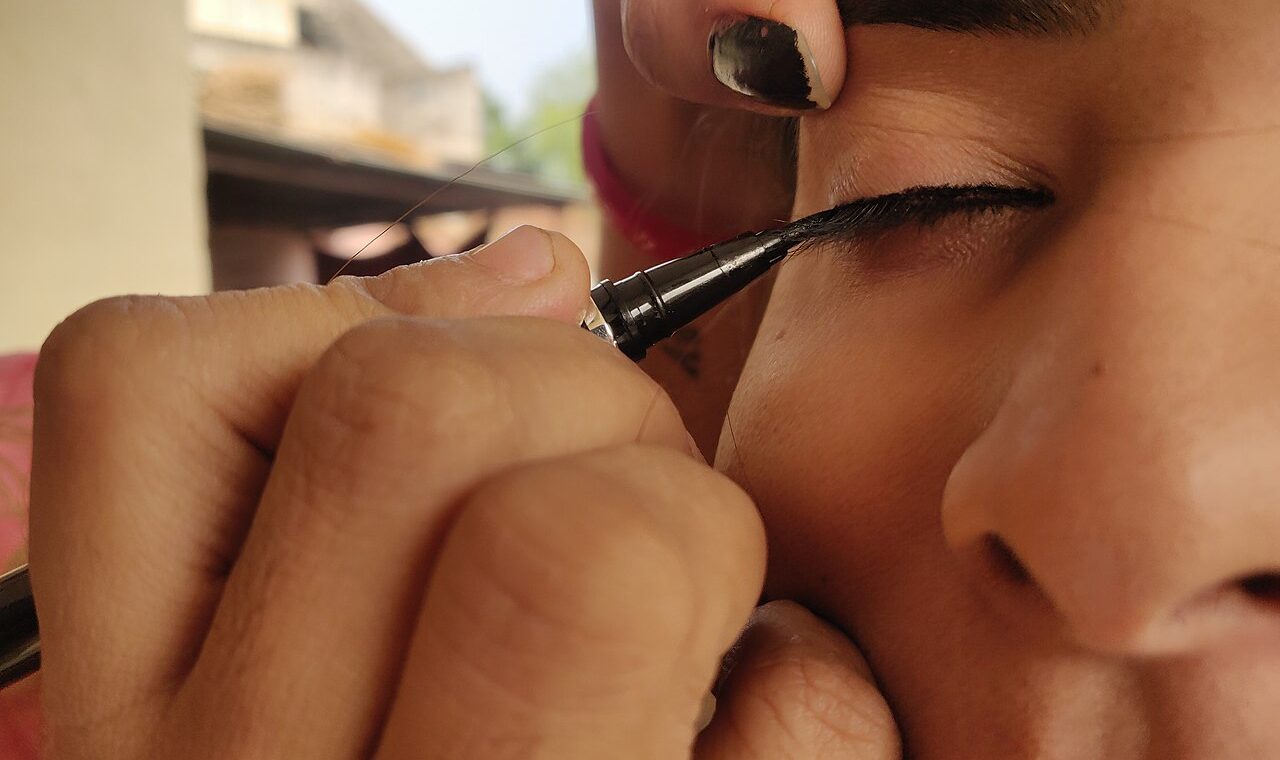
Why does a winged liner look perfect with your eyes closed and vanish the moment you open them?
Because the wing was drawn on a flat surface that becomes a fold when the eye opens.
Hooded eyes need a different geometry, and most tutorials do not account for it.
I tested four wing methods on three hooded eye shapes over a fortnight, photographing each with eyes open and closed.
Only one method held up in both states.
Here is the geometry and the technique.
What hooded actually means
A hooded eye has skin from the brow bone folding over the lid when the eye is open.
The amount of fold varies enormously between people.
The fold covers part of the lid space and, crucially, part of where a wing would sit.
That is why a wing drawn along the lower lash line disappears upward.
The liner is not gone; it is folded inside.
Understanding that makes the fix obvious.
It is a mapping problem, not a skill problem.
The standard wing and why it fails
The standard wing follows the lower lash line and extends upward and outward.
On a hooded eye, the fold begins exactly where the wing begins.
So the wing appears as a short stub, or vanishes entirely when the eye opens.
People then draw it thicker and longer, which looks heavy with the eye closed and still disappears open.
That escalation is the whole painful learning curve.
The answer is not more liner; it is a different angle.
More of the wrong thing never works.
The batwing method
Draw the wing with the eye open, not closed.
Look straight ahead into a mirror and mark where you want the tip to appear.
Then close the eye and connect that point back to the lash line.
When the eye opens, the shape reappears because it was drawn in the open state.
With the eye closed it looks strange and uneven, which is normal.
This is the only method that reliably works on a strong hood.
It requires trusting a shape you cannot fully see.
The floating liner method
Draw the liner above the fold, in the visible space when the eye is open.
It reads as a graphic line rather than a traditional wing.
It works well on deep-set hooded eyes and looks deliberate.
It does not suit everyone’s taste, and it is the most reliable shape of all.
No part of it can disappear, because none of it is under the fold.
Try it before deciding you dislike graphic liner.
Function sometimes dictates form.
The tightline method
Apply liner to the upper waterline rather than the lid.
It defines the lash line without occupying lid space.
The effect is subtle and completely fold-proof.
It works best with a soft pencil rather than a liquid.
For hooded eyes, tightlining plus mascara is often more flattering than any wing.
It also takes twenty seconds.
The simplest option is usually the best one here.
The smudged shadow method
Use a dark shadow on a small brush and press it into the lash line, then soften upward.
Shadow follows the fold rather than fighting it.
It also fades gracefully, which liner does not.
For a hooded eye, a smudged line often reads as more liner than it is.
This is the method I would recommend to anyone who has given up on wings.
It is forgiving of asymmetry and of a shaky hand.
Forgiveness is a feature, not a compromise.
Why the fold moves during the day
Hooded eyes change shape with fluid retention, sleep and allergies.
A wing that worked on Tuesday can fail on Friday for the same eye.
That is why some days feel impossible despite identical technique.
Drawing with the eye open accommodates the current shape rather than yesterday’s.
It also explains why photographs from different days do not match.
The eye is not a fixed canvas.
Work with the shape you have that morning.
Products that help
A fine-tipped liquid liner gives control for the batwing method.
A soft gel pencil is better for tightlining.
A small flat brush is best for the shadow method.
Waterproof formulas matter here, because hooded eyes transfer liner onto the fold constantly.
That transfer is the second most common complaint after disappearing wings.
Waterproof reduces it significantly.
Choose the formula for the transfer, not for the look.
The transfer problem
Liner on the lid touches the fold all day and prints onto the skin above.
A primer on the lid reduces it, and so does setting the liner with a matching shadow.
Setting is the more effective of the two.
Press a small amount of dark shadow over the liner with a flat brush.
That locks it and softens the edge at once.
Two birds, one brush.
Most liner complaints are really transfer complaints.
Symmetry and hooded eyes
Most faces are asymmetric, and hooded eyes are often asymmetric in how much they fold.
Drawing both wings identically produces a visible mismatch.
Draw each side separately, checking with the eye open.
Accept that they will not be identical and aim for balance instead.
Nobody is measuring your eyeliner with a ruler.
Balance reads as symmetry at conversational distance.
Precision is less important than consistency of impression.
Hooded eyes and shadow placement
Shadow on the lid disappears into the fold, so place it above instead.
Apply colour in the crease area that is visible when the eye is open.
That means working higher than instinct suggests.
Deep-set hooded eyes need the highest placement of all.
Avoid heavy shadow on the lower lash line, which drags the eye down.
Keep the emphasis upward and outward.
Direction matters more than colour.
What about false lashes
Lashes open up a hooded eye more effectively than any liner.
A short, fanned pair placed at the outer corner lifts the whole shape.
They also hide the join between liner and lash line.
For a hooded eye, lashes are the higher-value investment.
Liner defines; lashes open.
If you only do one, do the lashes.
That is the opposite of most tutorials.
When to skip the wing entirely
If the fold is deep and the lid space is small, a wing will always be a compromise.
A tightline, mascara and a soft crease colour will look better and take less time.
That is not giving up; it is choosing the shape that suits the eye.
Most makeup advice assumes a large visible lid.
Most eyes do not have one.
Adapt the technique rather than contorting the eye.
The eye wins every time.
The photograph test
Photograph your eye open and closed after every attempt.
Look at the open photograph, because that is how you are seen.
If the line is invisible in the open photograph, the method is wrong.
This test settles arguments with yourself faster than any mirror check.
It also shows you the shape that actually works.
Do it three times and you will have your geometry.
Three photographs, one permanent answer.
Liner and the inner corner
On a hooded eye, a bright inner corner opens the shape more than any wing.
Place a small amount of light shadow at the very inner corner, not along the lid.
Keep it narrow, or it reads as a stripe.
That single placement is the most efficient way to look awake.
It also never disappears into a fold.
Brightness at the inner corner is fold-proof by nature.
Use it before you attempt any wing.
The lower lash line on a hooded eye
A full lower line drags the eye down and closes the shape.
Instead, place colour only on the outer third and smudge it slightly.
That lifts the corner without adding weight underneath.
Keep the inner two thirds clean.
This is the difference between a lifted and a tired eye.
Placement again, not product.
Half a line often reads better than a whole one.
Removing a wing without wrecking the eye
Use a cotton bud with a little micellar water and roll rather than wipe.
Wiping removes the shadow underneath and leaves a patch.
Rolling lifts the liner and leaves the base intact.
If the mistake is large, remove the whole eye and start again.
Patching a failed wing always looks like a patch.
Starting over takes ninety seconds.
Pride costs more time than patience.
Which method suits your fold?
Try the batwing and the smudged shadow on separate days and compare the open-eye photographs.
One will look deliberate; one will look like a mistake.
Which one has been missing from your routine?